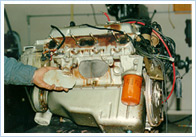

Here are some very specific preheating and welding
procedures to help you perform cast iron repairs that are predictable and
reliable.
Brazing
The casting must be preheated to
at least 900ºF before you begin increasing the temperature in the area you want
to braze. The bronze rod will melt at around 1725ºF. A good bonding
temperature is 1800ºF. The casting should be positioned so that you are
brazing on an incline of at least 30 degrees. Avoid "in
position" or flat brazing as this causes pin holes, cold laps, and burnt
edges. Brazing uphill allows you to fill the vee from bottom to top in one
pass. Small, thin steps allow you to move quickly and keep the area ahead
of the puddle tinned. Be sure to post heat to normalize the casting at
900ºF. Slow cool the part over 24 hours.
Many people believe bronze to be an inferior
metal to use on cast iron. Actually, bronze matches cast iron closely in
hardness and metal to metal wear resistance. Gray cast iron has a maximum
tensile strength of 40,000 PSI. And ductile iron (or nodular) can reach
75,000 PSI tensile strength. Common bare bronze is 70,000 PSi tensile
strength.
Fusion welding
Fusion welding is a skill that can
take years to master. It requires actual melting and puddling of base
metal as the filler material is added. Fusion welding is used primarily on
dense castings that can be machined after the welding is done. (Cylinder
heads are excellent subjects for fusion welding but engine blocks are
not.) A 1300ºF to 1500ºF preheat is required. For a heating
source, use natural gas or diesel fuel. Do not use propane. Use
oxy-acetylene gas and bare cast iron rod for the fusion welding process.
Heat the part and maintain it at bright red during the entire welding
procedure. Cast iron melts at approximately 2300ºF. A post heat of
1300ºF to 1500ºF for 15 minutes is needed. Slow cool the part over 24
hours.
Powder welding
Preheat the casting to 900ºF,
apply a light coat of powder to protect the surface from ferrite oxide deposits
and then continue the preheat to at least 1300ºF. During the build-up
process, the weld affected area can reach 1800ºF in the area the capillary bond
process takes place. Without high temperature preheat, powder welding
should be restricted to corners, ears and ends.
Corners, ears, and ends
It is impossible to create stress
on corners, ears and ends. A good illustration of this is if you welded
two pieces of welding rod together. The ends have nothing to expand
against, therefore there is no confinement. After joining the two pieces
together, the heated area can contract and shrink without creating stress.
If you must use a nickel rod on cast iron, use it only on corners, ears
and ends. Preheat the area with a torch to a dull red, arc weld it and
immediately post heat with the same torch. It is best to use two people,
one to preheat and post heat and the other to weld. Timing is
critical. You will also need to use less amps when the iron is
preheated. Your best bet is to learn how to braze and forget the arc
welder. (This also applies to tig and mig welding.)
Electric arc welding
This is the poorest of all choices
for welding cast iron. It would be nice if it would work, but it causes so
many problems it should be avoided if at all possible. The heat potential
is great and the process causes the heat to be too localized. Thin sections heat
faster and cool quicker than thick sections. If a section of the casting
is heated too quickly, the surrounding area does not have ample time to absorb
enough heat to allow the casting to have a uniform temperature. This
causes restricted expansion and contraction. It occurs when the weld
affected area is contained by cooler iron. This will
always result in some stress. Often it is enough stress to cause
additional cracking. There is no such thing as cold arc welding; cast iron
melts at 2300ºF. No professional industrial cast iron welder would ever
arc weld on a casting heated to less than 1000ºF.
Nickel rod
In our shop, we can tell no
difference between one manufacturer's rod and another. There are repairs
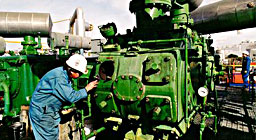
where we must use nickel rod, such as on compressors in the oil field. In
these cases, H2S gas is present and bronze is not acceptable.
We will preheat to 1200ºF before welding, followed by a long post heat to a
uniform 1200ºF before a 24 hour cool down. The critical part of the cool
down is from 1800ºF to 1200ºF.
Recap
Let's add together the things you have learned about expansion
and contraction along with temperature control and review the ways to prevent stress
from building up in your welded cast iron parts: